
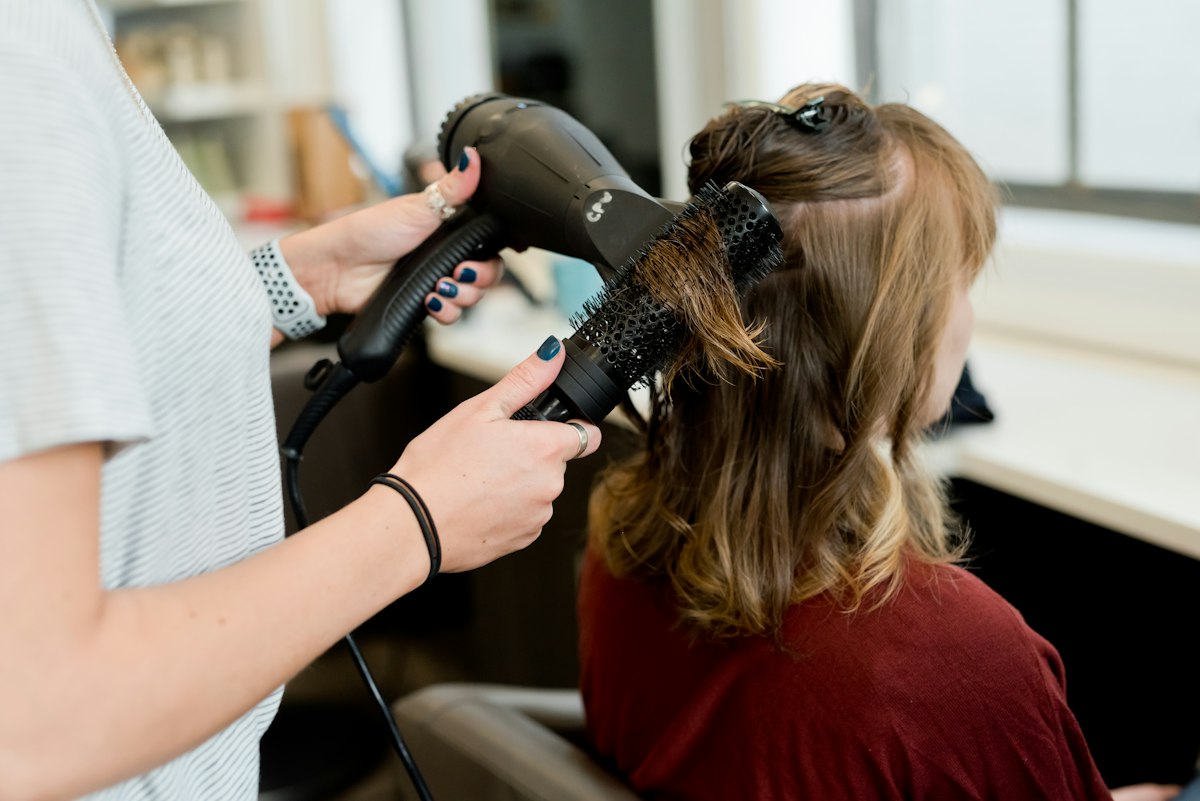
Hairstylist vs. Colorist: Who Should Do Your Color?
You've had the same person cutting your hair for years, and they're genuinely good at it. So when you finally decide you want balayage — or you're ready to stop fighting the grays — booking with them feels like the obvious move. Then the tone comes out a little off, the grow-out line shows up in six weeks instead of twelve, and you're left wondering whether you picked the wrong service or the wrong chair.
What's the difference between a hairstylist and a colorist?
A hairstylist and a colorist hold the exact same credential — a state cosmetology license. The difference is what they practice. A hairstylist's deep skill is in cutting, shaping, and styling. A colorist's deep skill is in the chemistry of color: formulation, lightening, toning, and placement. "Colorist" isn't a separate license. It's a description of what someone does all day, every day.
That distinction matters more than it sounds. Cutting and coloring are two genuinely different crafts that happen to share a license and a chair. One is spatial — how weight falls, how a shape grows out, how your cowlick behaves. The other is chemical — how much lift your hair can take before it turns to mush, why your ends grab warmth and your roots don't, what happens when a demi-permanent gloss hits porous mid-lengths.
Plenty of people are excellent at both. But most professionals drift toward one after a few years, simply because that's where their hours go. Someone doing four balayages a day has thousands of reps at reading undertone. Someone doing four haircuts a day has thousands of reps at reading a head shape. Neither is better. They're just built differently.
Do colorists get different training than hairstylists?
Yes — but it happens after licensing, not during it. Every licensed cosmetologist completes roughly 1,000–1,600 hours of state-approved training that covers color basics alongside cutting, chemistry, and sanitation. Colorists then spend years in brand education (Redken, Wella, L'Oréal, Goldwell) and sometimes pursue optional credentials like Board of Certified Haircolorist certification, which requires both a written and a practical exam.
Here's the thing about cosmetology school: it teaches you enough color to be safe, not enough to be a specialist. A licensing exam confirms you understand peroxide volumes and won't burn a scalp. It doesn't test whether you can look at hair that's been box-dyed twice, henna'd once, and beach-faded all summer and correctly predict what it'll do under bleach.
That kind of judgment comes from advanced education and volume. Manufacturer classes, hands-on intensives, color-correction workshops, and — most of all — years of watching your own formulas develop on real heads and adjusting. Certification is a genuinely good signal, but it's not the only one. A colorist with 15 years of dedicated color work and no certificate may well be more skilled than a freshly certified one.
| Hairstylist | Colorist | |
|---|---|---|
| License required | State cosmetology license | Same state cosmetology license |
| Where the deep skill sits | Shape, weight, texture, growth patterns | Color chemistry, lift, tone, placement |
| Best booked for | Cuts, blowouts, styling, gloss refreshes | Balayage, gray blending, blonding, correction |
| Typical appointment | 45–90 minutes | 2–4 hours (8+ for correction) |
| Handles color correction? | Sometimes — varies widely | Yes, it's core work |
| Plans your maintenance cadence | Around your cut schedule | Around how your color actually fades |
| What they ask about first | How you wear and style it | Your last 2 years of color history |
When does it actually matter which one you book?
It matters most when the service is chemical and hard to undo. Root touch-ups, single-process color, and gloss refreshes are safe with any capable stylist. Balayage, gray blending, dark-to-blonde lightening, and anything correcting previous color belong with a colorist — those services live or die on judgment calls about undertone, porosity, and exactly how far to push the lift.
Think of it like the difference between repainting a wall the same color and stripping four old layers off first. The first job is straightforward. The second one requires knowing what's underneath, and being right about it.
Lightening is the clearest example. Going from dark to blonde isn't one appointment — it's usually two to three sessions spaced 8–12 weeks apart, because the hair needs recovery time between rounds of lift. A colorist who does this constantly knows when to stop at level 7 and tone warm rather than chase level 9 and lose the hair's integrity. They'll also work a bond-builder like Olaplex or K18 into the lightening process, not as an upsell, but because it changes what the hair can survive.
Gray blending is the other one. Blending gray is deliberately not the same as covering it — you're softening the contrast between silver and your natural base so the grow-out reads as dimension instead of a stripe. That's a placement and formulation problem, and it's the difference between coming back every four weeks and coming back every ten.
Color correction is where the gap gets expensive. A standard color appointment takes 90 minutes to two hours. A real correction takes four to eight hours, often across multiple visits, and typically runs $150–$600 per session. Most of that cost is time and risk — someone is undoing chemistry on hair that's already compromised. If a salon quotes you $150 flat for a full correction, that's not a bargain. It usually means no strand test and a rushed process.
How much does booking a colorist cost in San Francisco?
In San Francisco, expect roughly $275–$650 for balayage, $125–$400 for full highlights, and $100–$200 for single-process color or gray blending, depending on your length and density. Color correction runs $150–$600 per session and frequently needs more than one. A specialist usually costs more per visit — and often less per year.
That last part surprises people. Specialist pricing looks higher on the receipt, but the math changes when you account for how often you're in the chair. Color placed with the grow-out in mind can stretch to 10–14 weeks between full appointments, with a gloss somewhere in the middle. Color placed without that thinking has you back in six. Two extra visits a year erases the price difference pretty fast — and that's before you count the corrections you didn't need.
San Francisco also has real pricing spread, and not all of it maps to skill. Rent, neighborhood, and how a salon structures gratuity all move the number. At Taylor Monroe, pricing is gratuity-free — the quote you get is the price you pay, with no mental math at the end. It's a small thing that removes a surprisingly annoying part of the appointment.
How do you find the right colorist — and what should the consultation feel like?
Look for a portfolio of real clients rather than brand models, with consistent tone, smooth blends, and hair that still looks healthy in the photo. Ideally, find work on hair that starts where yours does. Then judge the consultation itself: a good one is mostly the colorist asking questions. If someone recommends a service before asking about your color history, keep looking.
The questions worth listening for: What have you put on your hair in the last two years, including box dye and henna? How do you actually wear it day to day? How often do you realistically want to be here? What's your budget? A colorist who asks those before naming a technique is designing for your life, not just executing a photo.
Red flags are the mirror image. Promising level-9 platinum from a dark box-dyed base in a single session. Skipping a strand test on compromised hair. Getting vague when you ask what maintenance looks like. And the quiet one — a portfolio where every single photo is the same blonde on the same hair type. That's a signal about range, not skill, but it matters if your hair isn't that hair.
It's also fair to ask directly: is color what you specialize in? Most professionals will tell you honestly, and many will refer you to the colorist down the row if it's not their strength. That referral is a good sign about the salon, not a bad one.
At Taylor Monroe, color is the specialty rather than a side service — 17 years behind the chair, the last seven of them here in San Francisco, focused on gray blending, dark-hair color, balayage, blonding, highlights, and extensions. We keep two studios, one in the Lower Haight at 146 Fillmore St and one in the Castro at 228 Sanchez St, and both offer a free 15-minute consultation before you commit to anything. That consult exists so you can find out what your hair can realistically do — and whether we're the right fit — without booking a service first.
Frequently Asked Questions
Can a regular hairstylist do balayage?
Yes, many can. Balayage is taught in continuing education and plenty of stylists do it well. The real question is volume: someone painting balayage several times a week reads undertone and placement faster than someone doing it twice a month. Ask how often they do the specific service you want.
Is a colorist more expensive than a hairstylist?
Usually yes, per appointment. Specialists price higher because color services take two to four hours and require expensive product, and because advanced training costs money. Annually, though, the gap narrows — well-placed color stretches maintenance to 10–14 weeks instead of six, so you book fewer visits per year.
Should I get my cut and color done by the same person?
Not necessarily, and it's completely normal to split them. Many people keep a cutter they love and see a colorist separately. If you do split it, just tell each one what the other is doing — color placement and cut lines interact, especially with balayage and face-framing work.
How can I tell if someone is genuinely a color specialist?
Look at three things: whether their portfolio is mostly color work on varied hair types, whether they name specific techniques and brands they've trained in, and how they run a consultation. Specialists ask about your color history unprompted. Generalists tend to ask what you want and start mixing.
Do I need a colorist just for gray coverage?
For straightforward single-process root coverage, any experienced stylist is fine. For gray blending — softening the contrast so grow-out looks intentional rather than lined — book a colorist. Blending is a placement and formulation problem, and getting it right is what stretches your visits from four weeks to ten.
How long does a color appointment with a colorist take?
Plan for two to four hours for balayage or full highlights, 60–90 minutes for a single-process or gray-blending service, and four to eight hours for color correction. Lightening dark hair to blonde typically spans two to three separate sessions, spaced 8–12 weeks apart for recovery.
What should I bring to a color consultation?
Bring photos of what you want and, honestly, a photo or two of what you don't. Come with your color history ready — box dye, henna, old highlights, anything from the last two years. Arrive with your hair in its normal state, not freshly styled, so it can be read accurately.
The Bottom Line
The title on someone's booking page doesn't tell you much. The license is identical, so what you're really shopping for is where their hours have gone. If you want a shape that grows out beautifully, find someone who lives in cutting. If you want dimensional color that survives ten weeks and doesn't wreck your hair on the way there, find someone who lives in color chemistry.
Both can be true of the same person, and both are worth having. The only real mistake is assuming that because someone is great at one, they must be great at the other. If you're weighing a color change and want a straight answer about what your hair can handle, a free 15-minute consultation is a low-stakes way to find out — no commitment, no pressure, just a plan you can decide on later.