
Hydration Station: The Complete Routine for Moisture-Rich Hair
If your hair feels dry within a day of washing — or you keep reaching for more product and never quite getting there — you're not failing at haircare. You're probably missing a few key pieces in your routine. Moisture isn't about adding more. It's about building a system that helps your hair hold onto what it has.
Why Hair Gets Dry in the First Place
Dry hair isn't just a lack of moisture — it's a broken cycle of absorption and retention. Every strand has a cuticle layer made of overlapping cells that, when healthy, lie flat and lock hydration into the cortex underneath. When that cuticle is intact, hair manages heat, friction, and environmental exposure well. When it's lifted or damaged, moisture escapes as fast as it's absorbed, and no amount of conditioning product at the surface fixes that for long.
Cuticle damage accumulates from a lot of directions. Heat styling is one of the most consistent culprits — research has shown that daily blow-drying for even a month produces measurable cuticle lifting and protein loss in the shaft.
Chemical processes like color, bleach, and relaxers deliberately swell the cuticle as part of how they work, and repeated treatments without structural rebuilding in between leave the cuticle chronically lifted.
Environmental factors pile on quietly: UV exposure, cold and dry air, hard water minerals, and friction from rough pillowcases all degrade the cuticle over time without any single event you'd notice.
Hair porosity — how readily your hair absorbs and holds moisture — is the other variable most people overlook. High-porosity hair has gaps or lifts in the cuticle that let moisture flood in quickly and escape just as fast, so products seem to vanish and the dry feeling returns within hours. Low-porosity hair has a tightly closed cuticle that resists moisture uptake entirely, so products pool at the surface rather than penetrating. Knowing roughly where you fall changes what kinds of products and application techniques actually work for you.
Most moisture routines fall short because they treat symptoms — temporary softness after a wash — rather than the underlying structural condition. The goal is a routine that consistently delivers and seals moisture at the cuticle level so the results last more than a few hours.
What Hydrated Hair Actually Needs
A working moisture routine does three distinct things: cleanses gently without stripping the cuticle further, delivers moisture through ingredients that draw and hold water, and seals the cuticle afterward to slow moisture evaporation. Most routines are doing one or two of these. Getting all three in the right order is what makes the difference.
The cleansing step is where most people lose the most moisture without realizing it. Sulfate-heavy shampoos clean effectively but strip the natural oils that serve as the hair's first line of moisture protection — and for already-compromised hair, that repeated stripping keeps the cuticle rough and prevents any real baseline from building. Switching to a gentler, sulfate-free formula isn't about avoiding clean hair. It's about not undoing in two minutes what your conditioning routine spent a week building.
For conditioning, the ingredients that actually penetrate matter far more than what the packaging implies. Amino acids — particularly serine and glutamic acid, which are found naturally in keratin — work at the structural level, reinforcing the cortex from inside. Glycerin and similar humectants draw water molecules into the hair shaft and hold them there. Oils like sweet almond and argan provide occlusion: they slow the rate at which moisture evaporates from the surface. A well-built conditioner combines all three layers. A rinse-out conditioner that relies only on surface-coating silicones can produce softness but doesn't build anything lasting.
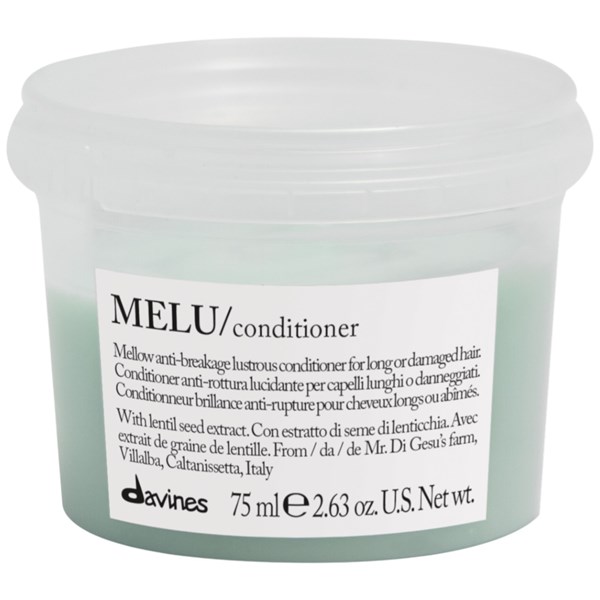
Davines MELU Conditioner: Where the Structural Work Happens
The MELU line from Davines was built specifically for long, fragile hair — strands that snap during detangling, lose elasticity over longer lengths, and struggle to retain moisture past the mid-shaft. That said, the core of what it does is useful for almost any dry or compromised hair, regardless of length.
The hero ingredient is lentil seed extract, sourced from a small farm in Villalba, Sicily as part of Davines' Slow Food Presidia sourcing program — a supply chain commitment that goes far beyond the usual sustainability claims. Lentil extract is rich in serine and glutamic acid, two amino acids that closely match keratin's natural composition and reinforce the hair's cortex from the inside rather than just coating the outside. That's a meaningful distinction: structural rebuilding versus surface softness. The formula rounds out with glycerin for water retention, sweet almond oil for occlusion, and amodimethicone for a smooth, anti-static finish. It's a light texture — it doesn't weigh down fine or medium-weight hair, which is often the hesitation with anything marketed as 'nourishing.'
Application is straightforward: mid-lengths to ends after shampooing, two to three minutes, rinse with cool water to close the cuticle. The difference shows up most in detangling — less breakage, smoother glide — which for fragile or color-treated hair is often where a significant portion of daily damage actually happens. Consistent use over two to three weeks is when the cumulative benefit becomes obvious: hair that doesn't break as easily, dries with more of its natural texture intact, and holds moisture longer between washes.
Editor's Pick
Featured Product
Davines | MELU Conditioner
Lentil extract and amino acids rebuild fragile hair from the cortex up — light formula, lasting results.
Sponsored
Building a Routine That Keeps Moisture In
Wash frequency is part of the formula. Dry hair benefits from washing two to three times a week at most — each wash removes some of the scalp's natural oils that form the hair's baseline moisture layer, and frequent washing keeps hair in a cycle of stripping and recovering rather than getting to build anything lasting. On non-wash days, a light leave-in or mist handles surface dryness without disturbing that oil balance. If your hair is very oily at the roots but dry at the ends, you may need to co-wash (condition-only wash) the ends more often while keeping shampooing to a minimum.
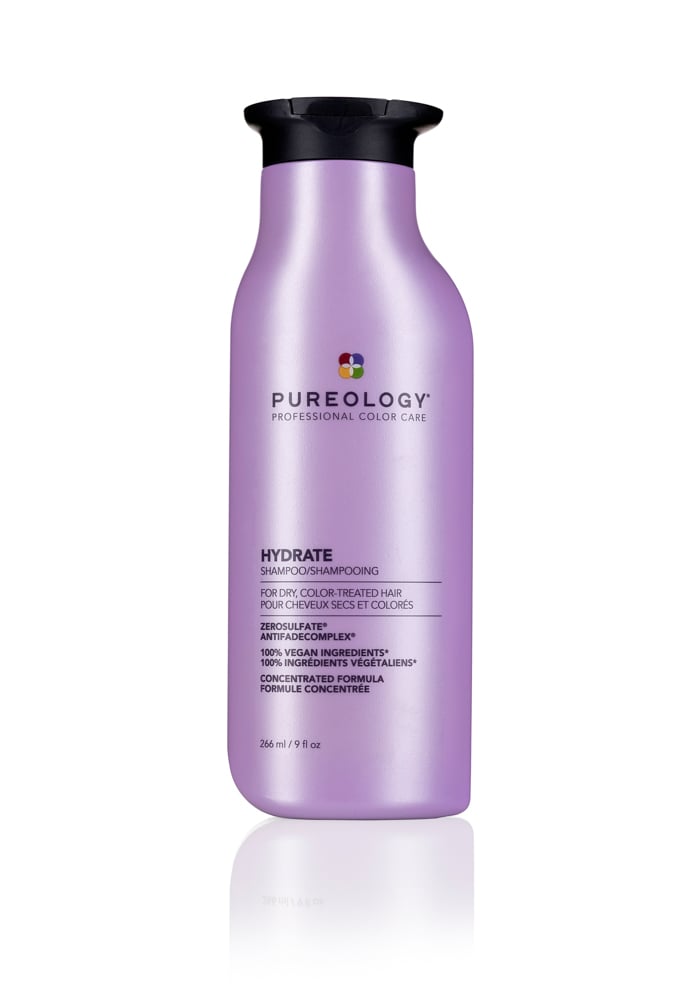
The shampoo step sets the foundation for everything that follows. A hydrating, sulfate-free formula cleanses effectively without aggressively stripping — it removes buildup, environmental residue, and excess scalp oil while leaving the moisture layer intact. Apply shampoo only at the roots and scalp where oil actually accumulates. Let it work down through the lengths during the rinse rather than scrubbing mid-shaft or ends, which are already the most fragile and dry sections of the strand. The AIIR Hydrate Shampoo does exactly this kind of restrained, targeted cleansing — formula built to get the scalp clean without punishing the lengths.
After shampooing, follow with your conditioner on mid-lengths and ends. Use a wide-tooth comb while the conditioner is in to distribute it evenly and work through any tangles while the hair has slip and protection. Rinse with cool water at the end to close the cuticle rather than leaving it lifted. This last step is small but real — hot rinse-water keeps the cuticle open and actively accelerates moisture loss after you step out of the shower.
Editor's Pick
Featured Product
AIIR | Hydrate Shampoo
Sulfate-free hydrating formula that cleanses without stripping — the foundation every moisture routine needs.
Sponsored
What Most People Get Wrong About Moisturizing Hair
The most common mistake is layering moisturizing products onto structurally damaged hair and expecting lasting results. If the cuticle is lifted and the cortex is depleted, surface conditioning produces temporary softness that's gone by the next day. The foundational fix is consistent use of amino acid-based treatments that rebuild over time — not heavier masks applied once in a while. Think of it as a weekly deposit into a bank account rather than an occasional large transfer. The balance builds gradually, but the compound effect over a month is real.
Second: conditioning the ends only. Dryness and visible damage are most obvious at the tips, so that's where most people focus. But the mid-lengths — especially on hair past shoulder length — need equal conditioning attention. That's where structural weakening accumulates before it becomes obvious as split ends, and it's also where most of the daily mechanical stress from styling and friction happens. Mid-lengths to ends, every wash, not just the last few inches.
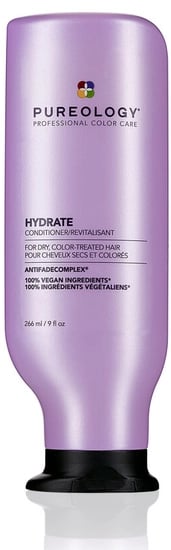
Third: treating every wash day identically regardless of what the hair has been through. Hair after a heavy color service, a week of heat styling, or extended outdoor exposure in sun and wind needs more intensive conditioning support than a standard maintenance wash. On those days, a richer conditioner provides a higher concentration of nourishing ingredients than your regular formula — the AIIR Hydrate Conditioner is the kind of product worth cycling in for that purpose. It delivers more concentrated conditioning than a daily formula while staying light enough to use regularly rather than rationing it for emergencies. The result is detangled, noticeably softer hair that builds on the work you're doing with your regular routine rather than just patching over the worst days.
Editor's Pick
Featured Product
AIIR | Hydrate Conditioner
Richer conditioning that restores softness and manageability after heat, color, or heavy daily wear.
Sponsored
The Bottom Line
Moisture-rich hair isn't a product problem — it's a system problem. When your shampoo strips more than it should, your conditioner doesn't contain the right structural actives, and your wash frequency works against you, no single product can fix that. But when the pieces are aligned — a gentle cleanser that doesn't undo your work, a conditioner built around amino acids and humectants rather than just silicones, and a wash rhythm that lets your hair stabilize between sessions — the improvement compounds over a few weeks until you barely have to think about it.
Your hair will tell you when the routine is working. Less breakage during detangling. Longer-lasting softness between wash days. Less frizz that you have to manage with additional products. That's the signal you're building something real, not just masking the problem one wash at a time.
