Red Light Therapy for Hair Growth: Does It Actually Work?
Picture this: you're standing at the bathroom sink, watching the drain slowly disappear beneath a small net of shed hair, and thinking — there has to be something actually worth trying. The answer, increasingly, is sitting on top of your head. Red light therapy has moved firmly out of the realm of biohacker curiosity and into real dermatology offices, peer-reviewed journals, and the daily routines of people who are very tired of false promises.
The Problem With Hair Loss (And Why It's So Hard to Fix)
Hair loss is one of the most emotionally loaded beauty concerns there is — and one of the least straightforward to treat. Androgenetic alopecia, the clinical term for pattern hair loss, affects an estimated 50% of women by age 50. The numbers for men are even starker. But hair loss is rarely a single problem with a single fix. It's a cascade: fluctuating hormones, elevated DHT (dihydrotestosterone), chronic scalp inflammation, compromised circulation, nutritional gaps, stress. Often several of these at once.
The frustrating reality is that most people approach hair loss from the outside in — shampoos, serums, scalp masks — when the real issue is what's happening inside the follicle. Hair follicles that have been chronically deprived of blood flow and nutrients don't respond to products the way healthy follicles do. They miniaturize, produce weaker, finer strands, and eventually stop producing hair altogether. You can layer on the best topical products available, and if the follicle itself is dormant, you're not going to see meaningful results.
This is why so many over-the-counter hair loss solutions disappoint. They may address one piece of the puzzle — DHT suppression, or scalp exfoliation — without tackling the follicle's underlying energy deficit. And here's precisely where the science around red light therapy starts to get interesting. Because unlike most hair loss treatments, it doesn't bypass the biology. It works with it.
What to Look For: The Science Behind the Light
Red light therapy — also called low-level laser therapy (LLLT) or photobiomodulation — works on a principle that sounds almost too elegant: specific wavelengths of red light penetrate the scalp and are absorbed by the mitochondria in your follicle cells. This triggers a measurable increase in ATP (adenosine triphosphate), the molecule that powers all cellular activity. More ATP means more energy for growth, repair, and regeneration. The follicle cells that had gone quiet start getting the signal to wake up.
The wavelength matters enormously here. Research consistently points to 630–660 nm as the optimal range for scalp penetration and follicle stimulation. At this wavelength, light reaches approximately 5mm below the skin surface — deep enough to interact with the follicle bulb, where growth actually originates. Red light at this frequency also stimulates vasodilation, widening the blood vessels feeding the scalp so that more oxygen and nutrients reach the follicle over time.
The clinical evidence has become genuinely robust. In 2025, a consensus review from over 20 specialists confirmed red light therapy is both safe and effective for androgenetic alopecia. A real-world study of 1,383 patients found clinical effectiveness rates of nearly 80%. Separate randomized controlled trials showed hair density improvements of up to 43% over 24 weeks of consistent use. The FDA has cleared multiple home devices in this category, and dermatologists now recommend LLLT as a first-line adjunct to other treatments — not a last resort for when everything else has failed.
HigherDOSE Red Light Hat: The Device That Changed the Game
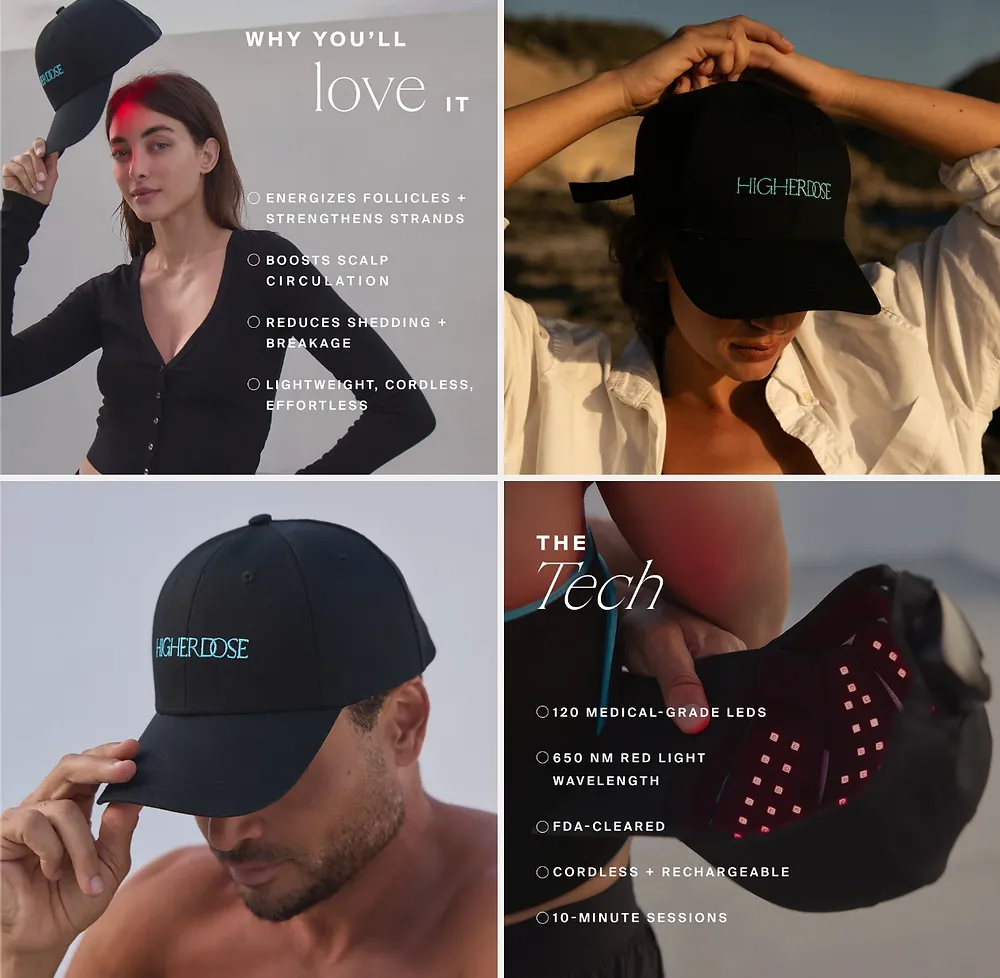
If you've been paying any attention to the wellness space, you know HigherDOSE. The brand built its reputation on infrared sauna blankets and biohacking tools that hold up to scrutiny — and their Red Light Hat is no exception. Inside what looks outwardly like a completely normal baseball cap are 120 medical-grade LEDs emitting at precisely 650 nm, arranged to provide full-scalp coverage. The protocol is ten minutes a day. That's it.
What makes HigherDOSE worth the investment is the combination of clinical precision and genuine usability. Most red light hair devices are ungainly helmets that require you to sit stationary for sessions — which sounds fine until the novelty wears off and it starts collecting dust. The hat format removes that friction entirely. You wear it while you drink your morning coffee, while you answer emails, while you do basically anything that doesn't require leaving the house. The coverage is full-scalp, which matters: devices that only treat one zone at a time mean you're waiting twice as long for comprehensive results.
HigherDOSE's own clinical survey of 28 users over 16 weeks found that 93% noticed overall scalp and hair health improvements, 86% reported visible hair growth, and 83% noticed growth in sparse or thinning areas. Those aren't large-scale pharmaceutical trial numbers, but they're consistent with what broader LLLT research shows: expect the earliest changes — reduced shedding, slightly thicker texture — around weeks 8 to 12, with meaningful density improvements showing up between months four and six. The word that appears in every credible study on this topic is consistent. There are no shortcuts here, but the payoff is real.
The Routine: How Red Light Fits Into Your Haircare
Red light therapy isn't a standalone fix, and the dermatologists who recommend it most enthusiastically are also the clearest about this. Think of LLLT as raising the floor of your follicle health. Once your follicles are energized and scalp circulation is optimized, everything else you apply — serums, treatments, targeted shampoos — works more effectively. The protocol makes your entire routine more efficient.
The mechanics are straightforward. Use your device on a clean, dry scalp three to four times a week. Scalp oils and product residue can block light penetration, so always treat after washing, before you apply any post-wash treatments. Ten minutes is clinically sufficient. Resist the urge to push to daily sessions immediately — ramp up gradually if you have a reactive scalp, and give your follicles time to respond to the increased cellular activity before stacking more stimulation on top.
After your red light session, your scalp's blood vessels are dilated and follicle cells are primed for absorption. This is the ideal window to apply a targeted growth serum. Calacium Hair Serum was formulated precisely for this moment. Built around stem cell-derived growth factors — specifically, cord lining conditioned media from ethically sourced red deer umbilical cord stem cells — just one milliliter of the active ingredient contains at least 3,000 growth factors, proteins, and cytokines. These molecular signals tell follicle cells to increase production while simultaneously suppressing the inflammatory cues that trigger follicle cell death. Clinical data shows a 24% increase in hair follicle cell growth and a 30-fold reduction in inflammatory signaling. Applied directly post-session, Calacium picks up exactly where the light therapy leaves off: the follicles are energized, and the serum delivers the biological instructions they need to translate that energy into actual hair. Most users report a visible reduction in shedding by week six, with regrowth becoming apparent around the twelve-week mark.
Pro Tips and the Mistakes Most People Make
The single biggest mistake people make with red light therapy is inconsistency. This is not a treatment where you can go two weeks on, two weeks off and still expect results. Hair follicles cycle slowly — the entire point of LLLT is to shift follicles from a resting phase (telogen) back into an active growth phase (anagen). That biological process takes months, and skipping sessions interrupts the signaling cascade you've worked to establish. Put the hat where you'll see it every morning. Make the friction as low as possible. The people who see results are the ones who build the habit.
The second overlooked piece is the scalp environment itself. Red light can stimulate follicle activity, but if your scalp is congested with DHT, chronically inflamed, or stripped of its natural oils, you're working against yourself. This is where your shampoo matters more than you might expect. Most conventional shampoos are formulated for the hair shaft — not for creating the conditions follicles need to thrive. If density is your goal, that distinction is important. DS Labs Revita Antioxidant Hair Density Shampoo was built around this problem. It combines 150mg of broad-spectrum CBD with ketoconazole, caffeine, ashwagandha, and superoxide dismutase — an antioxidant that protects follicles from environmental oxidative stress. The CBD-ketoconazole-caffeine combination targets DHT directly at the scalp level, blocking the hormonal conversion that miniaturizes follicles over time. It's sulfate-free, safe for color-treated hair, and among the most ingredient-serious density shampoos currently available.
Use it two to three times per week on wash days. On non-wash days, a simple rinse preserves your scalp oils without buildup. On your red light therapy days, this is step one: cleanse with Revita, do your HigherDOSE session, apply Calacium serum. Three steps, each doing something distinct. One more thing worth repeating: be genuinely patient with the timeline. Every credible study on LLLT is consistent — four to six months of regular use is where the meaningful density changes emerge. If someone is promising you faster results, scrutinize the evidence very carefully.
The Bottom Line
Red light therapy for hair growth isn't a trend. It's a treatment modality with a decade of FDA clearances, peer-reviewed research, and increasingly robust real-world data behind it. What's changed recently is accessibility — devices like the HigherDOSE hat have made clinical-grade wavelengths genuinely wearable, and the science around pairing LLLT with targeted topicals has gotten significantly more sophisticated.
The protocol that makes the most sense, based on everything the research actually shows: stimulate the follicle with red light, support the scalp environment with a density-focused shampoo like DS Labs Revita, and deliver the molecular growth signals with a serum like Calacium. None of these steps is optional if you're serious about results. They're each addressing a different piece of the same biological puzzle — follicle energy, follicle environment, and follicle signaling.
Hair loss is one of those concerns that rewards the systematic and consistent over the impulsive and impatient. If you've been cycling through products hoping something sticks, this is your invitation to build a real protocol instead. Start with the light. Give it six months. The science says it's worth the patience — and so does the growing chorus of people who finally have the results to show for it.
