Your Shower Water Might Be Ruining Your Hair — Here's the Fix
Your Shower Water Might Be Ruining Your Hair — Here's the Fix
You've tried the masks, the oils, the bond-building treatments. Your hair still feels dry and snaps at the ends, your color fades faster than it should, and no matter how much conditioner you use, that rough, coated texture just won't quit. The culprit probably isn't your products. It's your water.
What Hard Water Is Actually Doing to Your Hair
Hard water — water with elevated concentrations of dissolved minerals like calcium, magnesium, and iron — is the reality for roughly 85 to 90 percent of American households. Only about 15 percent of the U.S. has naturally soft water, mostly in the Pacific Northwest, New England, and pockets of the Southeast. If you live anywhere else, and especially if you're in the Midwest (where water averages a jaw-dropping 16 grains per gallon), hard water is almost certainly part of your daily routine.
Here's the problem: every time you wash your hair, those positively charged mineral ions — calcium (Ca²⁺), magnesium (Mg²⁺), iron — cling to the hair cuticle and build up in layers. Regular shampoo can't remove them. Over time, this mineral film creates a barrier that prevents moisture from penetrating the hair shaft, raises the hair's pH (making it more alkaline and reactive), and literally roughens the surface of the cuticle, increasing friction between strands. That friction is what causes breakage, frizz, and that strange stiff feeling that no conditioner seems to fix.
If you color your hair, hard water compounds the problem. Copper — a common trace mineral in hard water — catalyzes the hydrogen peroxide used in bleach and color services, which can accelerate chemical reactions, intensify damage, and cause your color to shift in unexpected directions. Copper is specifically responsible for unwanted green casts on light or blonde hair and contributes to the brassy, washed-out tone that makes freshly colored hair look weeks old within days. It's also why color-treated hair is disproportionately vulnerable to hard water — the cuticle is already compromised from chemical services, making it even more porous and even more receptive to mineral deposits.
A peer-reviewed study published in the International Journal of Trichology confirmed that hard water negatively affects hair's mechanical properties, though the researchers noted cumulative, long-term exposure drives the most significant damage. In other words: it gets worse the longer you ignore it.
What to Actually Look For (In Products and Solutions)
Once you understand that hard water damage is fundamentally a chemistry problem — minerals bonding to your hair and blocking everything else from working — you can approach it with a clearer strategy. You need two things: something that removes mineral buildup from your hair, and something that repairs the damage already done.
For removal, look for chelating agents in your shampoo and hair products. Chelating agents bind to metal ions and form stable complexes that rinse away with water. The most effective ones are EDTA (ethylenediaminetetraacetic acid), citric acid, phytic acid, and sodium gluconate. Citric acid in particular has strong research backing for dissolving calcium deposits — it works by binding mineral ions and converting them into soluble salts that wash out cleanly. Phytic acid is a gentler, plant-based option worth seeking out if your hair is color-treated or on the finer side. The key is to use chelating formulas regularly but not obsessively — once or twice a week for most people, once a month if your hair is very sensitive — and always follow with a deep conditioning treatment, because chelation strips buildup and needs to be counterbalanced with moisture.
For repair, the science has evolved significantly. Traditional conditioning agents coat the outside of the hair shaft, which offers temporary smoothness but does nothing to address structural damage. Bond-building technology — particularly the newer generation of biomimetic peptide treatments — works from the inside out, reconnecting broken polypeptide chains within the hair fiber itself. This is the category of product that actually changes the tensile strength and elasticity of damaged hair, not just its surface feel. When you're dealing with hard water damage, internal repair is not optional. It's the difference between hair that looks healthy temporarily and hair that actually gets stronger over time.
The Filterbaby Faucet + Shower Filter Bundle — Start at the Source
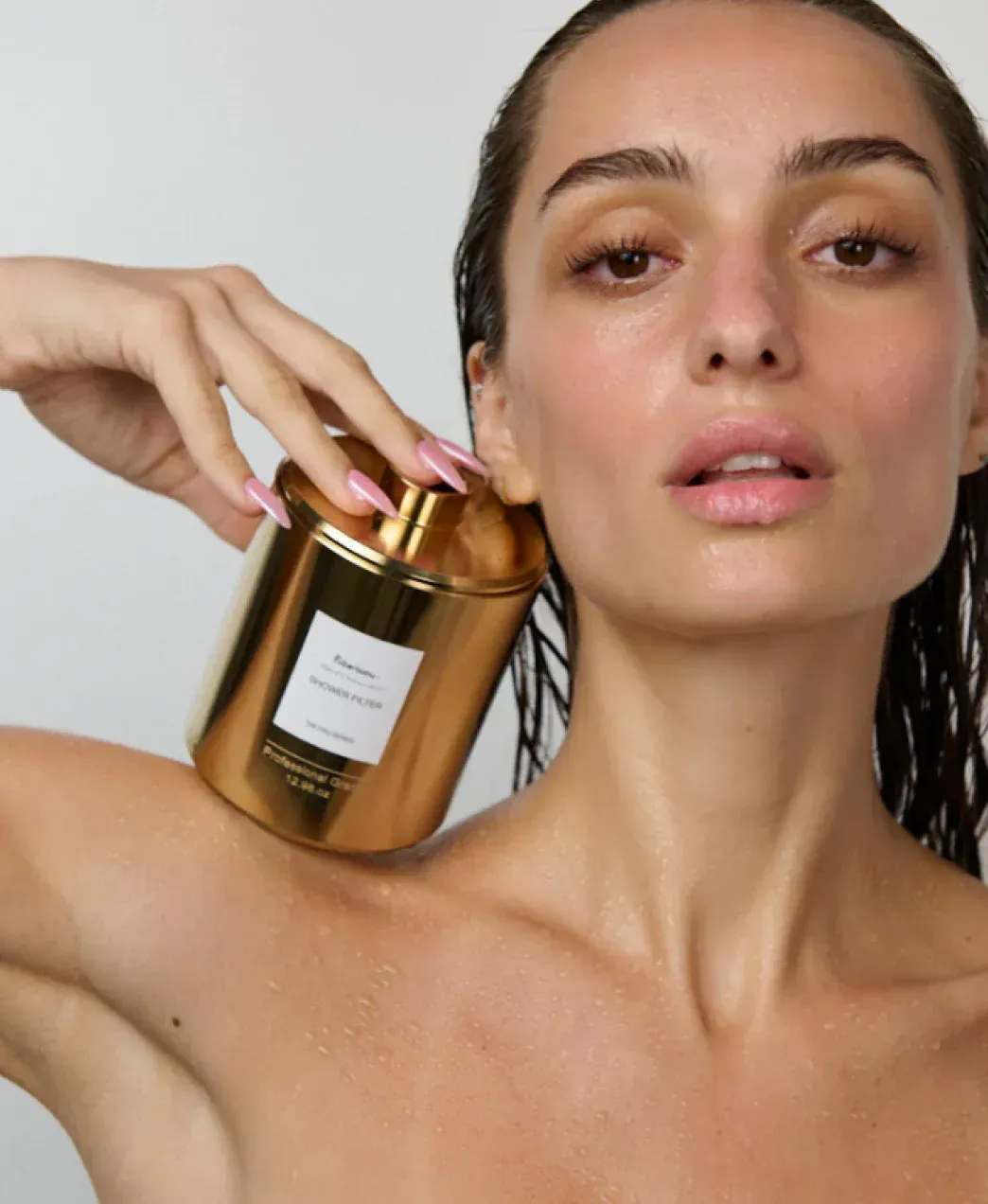
No amount of product will fully counteract hard water if you're still washing your hair in it every day. The most efficient single upgrade you can make is to filter your shower water before it touches your hair — and the Filterbaby Faucet + Shower Filter Bundle is the smartest way to do it.
Filterbaby's filters are engineered specifically to target the minerals that cause the most hair and skin damage: calcium, magnesium, chlorine, chloramine, and heavy metals including copper. Most generic shower filters tackle chlorine but leave the harder mineral deposits largely intact — which is fine for sensitive skin but doesn't address hair damage at its root. Filterbaby's multi-stage filtration is designed to reduce the full mineral load, not just the basics, which means the water hitting your hair is measurably softer by the time it makes contact with your cuticles.
The practical difference is immediate. Hair rinses cleaner, products lather more easily (hard water actively interferes with surfactant performance in shampoo, which is why your lather feels weak in hard water), and your leave-in conditioners and treatments absorb the way they're supposed to rather than sitting on top of a mineral film. Color-treated hair holds its tone longer. Scalp irritation eases. It's one of those changes you don't fully appreciate until you experience it — and then it becomes entirely non-negotiable. Think of filtered water as preparing the canvas: everything you apply afterward actually works.
Building a Hard Water Routine That Holds
Filtering your water addresses ongoing mineral exposure. But if you've been washing in hard water for months or years, you also have layers of existing buildup to clear and structural damage to reverse. Your routine needs to account for both — and it needs to be consistent, because the effects of hard water are cumulative in both directions. Damage accumulates over time, and so do improvements.
Start with a chelating wash once or twice a week. Apply the chelating shampoo to wet hair and let it sit for two to three minutes before rinsing — this contact time matters for mineral dissolution. Follow immediately with a deep conditioning mask and leave it on for at least ten minutes. This sequence — chelate, then deeply condition — is non-negotiable. Chelation alone will leave hair clean but stripped, and you need to rebuild moisture at the same time you're removing buildup.
Between chelating sessions, use a sulfate-free shampoo that cleans without further stripping. Sulfate-free formulas won't eliminate the mineral film the way chelating will, but they also won't exacerbate dryness or agitate an already-disrupted cuticle. Think of them as maintenance rather than treatment. The distinction matters because hard water hair is almost always compromised at the cuticle level, and gentleness during non-treatment wash days preserves the repair work you're doing on other days.
This is where the K18 Leave-In Molecular Repair Treatment becomes the backbone of the routine. Unlike topical conditioners that only address the surface, K18 uses a biomimetic peptide — the K18PEPTIDE™ — that was developed after analyzing over 1,235 peptide sequences from the human hair genome. The result is a peptide engineered to fit precisely into broken polypeptide chains within the hair fiber, reconnecting them and restoring tensile strength from the inside. Apply it to damp, freshly washed hair, wait four minutes for the peptide to fully absorb, and style as usual. No rinsing. It remains in the hair structure and continues strengthening bonds over time — unlike rinse-out treatments that you wash away along with everything else. For hard water hair, which has typically sustained both mineral damage to the cuticle and structural protein degradation, the combination of external chelation and internal molecular repair is transformative in a way that neither approach achieves alone.
The Mistakes That Keep Hard Water Hair Stuck
The most common mistake is treating hard water damage as a product problem rather than a system problem. It's easy to blame your shampoo or keep swapping conditioners when your hair won't respond — but if the water itself is depositing minerals faster than your products can address them, you'll be stuck in that loop indefinitely. The fix is upstream. Filtration first, then a consistent maintenance routine, then targeted repair treatments. No single product works in isolation here.
The second most common mistake is over-clarifying. Chelating shampoos are effective precisely because they're aggressive — they strip buildup, but they also strip natural oils and can disturb the hair's moisture balance if used too frequently. For most hair types, once a week is the upper limit. For color-treated, curly, or fine hair, once or twice a month is more appropriate. Always follow with deep conditioning, and never chelate before a color service without rebuilding moisture thoroughly — starting color on over-stripped hair accelerates damage.
There's also a timing mistake worth knowing about: applying your conditioning and repair treatments before the chelating step renders them useless. Mineral buildup forms a barrier that blocks absorption, which means even the best mask won't penetrate if it's sitting on top of a mineral film. Always chelate first, then condition. In the same vein, don't skip your repair treatments on wash days when you're not chelating — hard water hair needs consistent rebuilding, not just periodic maintenance.
The K18 Molecular Repair Hair Oil — Your Finishing Shield
Once you've cleared the mineral buildup and started rebuilding internal bonds, you need something that addresses the outermost layer of the hair fiber and protects against the heat and friction of everyday styling. The K18 Molecular Repair Hair Oil does something most oils don't: it works on two levels simultaneously. The K18PEPTIDE in the formula goes to work on deeper damage that causes frizz — the kind that lives inside the fiber, not on its surface — while a blend of avocado oil, sunflower oil, hemisqualane, and squalane smooths and nourishes the cuticle layer you can see and feel. The result is that the oil doesn't just coat the outside of the hair (which is what traditional serums and oils do, and why they only temporarily tame frizz). It actually reduces the frizz-causing damage at the source.
The other thing that makes this oil genuinely useful for hard water hair is what it doesn't contain: silicones. Silicone-based serums and oils are the number one contributor to product buildup, which compounds the mineral buildup you're already working to clear. A silicone-free molecular oil with heat protection up to 450°F adds a practical layer of defense against styling damage without adding to the buildup problem. Apply it to damp or dry hair before heat styling, or use it as a finishing oil to smooth flyaways after. It's lightweight enough for fine hair, which makes it the rare oil that actually works universally.
The Bottom Line
Hard water hair damage is relentless because it's ongoing — every shower redeposits minerals, re-raises your hair's pH, and re-creates the barrier that keeps your products from working. The good news is that the solution is equally systematic. Filter the water. Chelate consistently. Rebuild structure from the inside with molecular repair technology. Finish with a protective oil that doesn't undo your work.
What changes when you address hard water properly isn't just that your hair feels better — it's that your entire routine finally works the way it's supposed to. Products absorb. Color holds. Hair grows longer and stronger because it's not breaking at the same rate it's growing. The investment is mostly in understanding the problem correctly. Once you do, the path forward is clear.
Your water has been working against you this whole time. Now you know how to work around it.
